
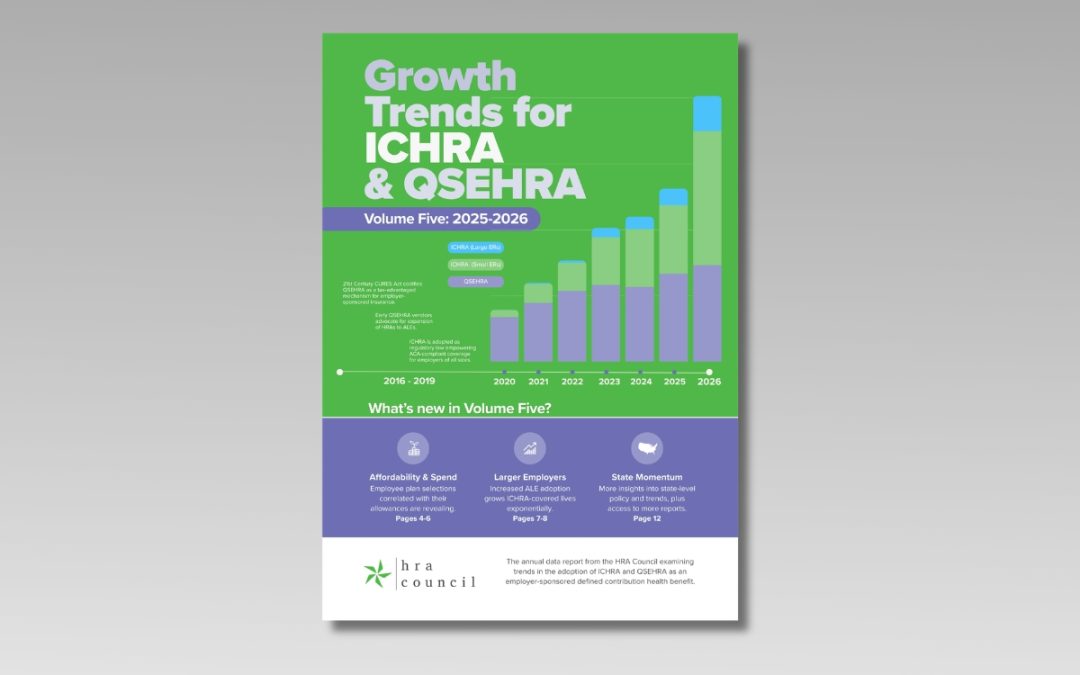
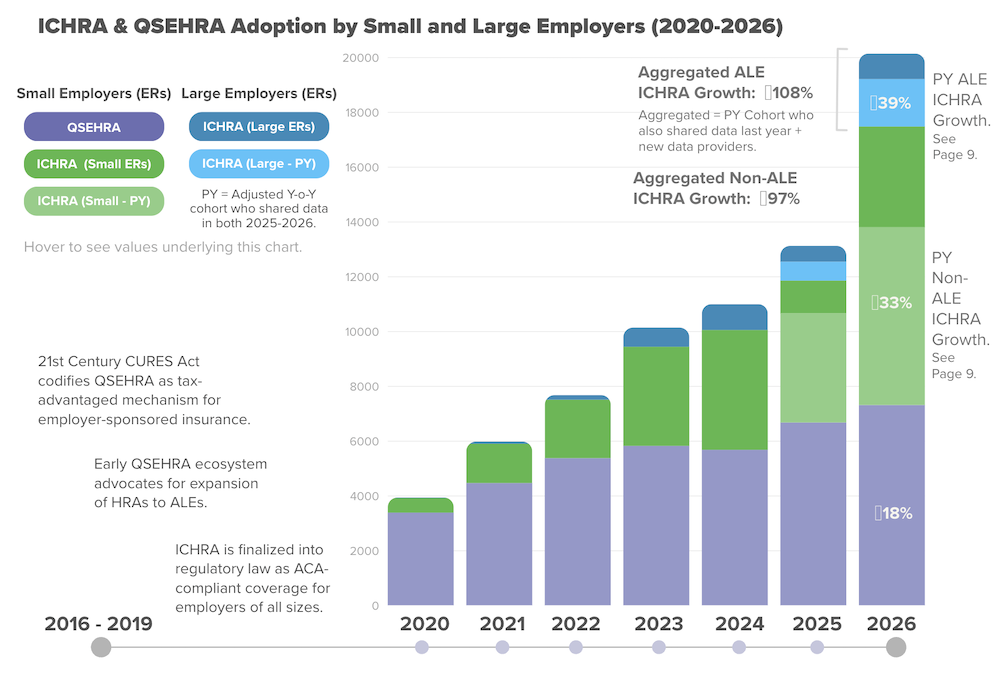
More than 20,000 businesses across the country now offer an ICHRA or QSEHRA, covering at least 500,000 Americans. This benefits model is showing up in state legislatures, employer strategy meetings, and broker pitch decks, including here in Georgia.
Individual Coverage Health Reimbursement Arrangements, better known as ICHRA, let a business reimburse employees tax-free for individual health insurance instead of buying a group plan. They are increasingly becoming a deliberate business and benefits strategy among large and small employers alike.
The HRA Council, the nation’s leading non-partisan authority on health reimbursement arrangements, released Volume Five of its annual Growth Trends for ICHRA & QSEHRA report earlier this month, and the numbers explain the reasoning behind this seemingly sudden attention.
Key findings from the HRA Council report
First introduced on January 1, 2020, ICHRAs are now over six years old and continuing to gain traction among businesses and legislatures across the U.S.
Source: HRA Council, Growth Trends for ICHRA & QSEHRA, Volume Five (2025-2026)
Applicable Large Employers are the fastest-growing segment of ICHRA adoption. Counting every platform that shared data, adoption among large employers grew 108 percent over last year. Comparing only the platforms that reported in both years, the more conservative measure, growth still came in at 39 percent. Either way, these are the employers multiplying ICHRA-covered lives the fastest.
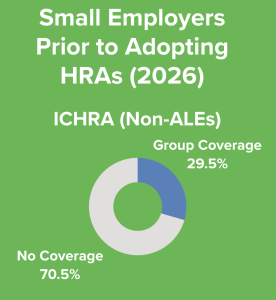
Small employers are moving too, and for a different reason. More than two-thirds of small businesses offering ICHRA in 2026 had never offered any health coverage before. Nearly a third of small employers who adopted ICHRA moved away from the small group market, which the report describes as an increasingly challenging place for small businesses to find affordable coverage.
Source: HRA Council, Growth Trends for ICHRA & QSEHRA, Volume Five (2025-2026)
The report also tracks “stickiness,” or the proportion of businesses who switch to ICHRA and stick with it. By overwhelming margins, employers who adopt an ICHRA keep it, and almost nobody returns to small group coverage or drops benefits altogether.
Employees are leaning into the choice
More than half of enrollments are coming from employees under the age of 45, and those employees are choosing Silver and Gold plans with richer benefit coverage more often than other tiers.
The report found that 19 percent of employees selected plans priced at or below their employer’s contribution, meaning the allowance covered the plan in full. The other 81 percent added their own money on top of the employer contribution to secure richer coverage. Across the full sample, the median allowance came to $459 per covered life against a median premium of $567.
Employees, the data shows, are enjoying having choice in their benefits coverage. Bringing younger workers more fully into the individual market is helping stabilize risk pools in all 50 states and the District of Columbia.
Georgia is in an especially good position
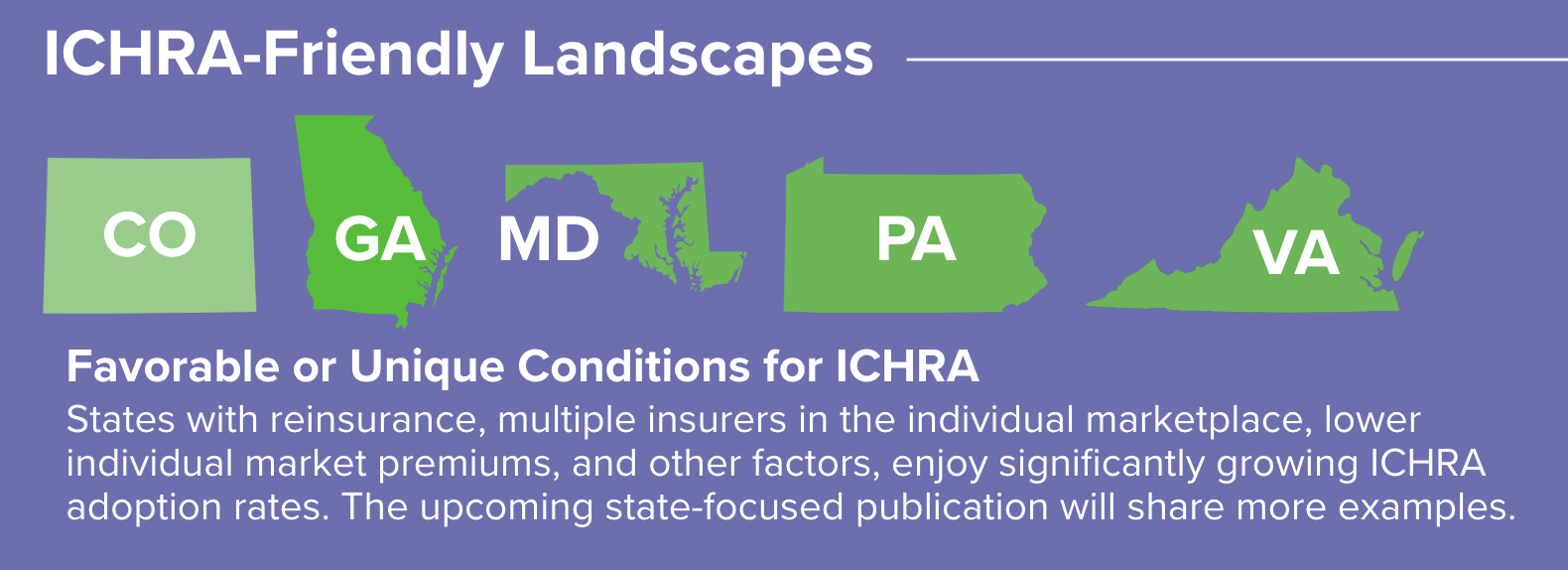
The HRA Council names Georgia directly. In its state momentum breakdown, Georgia appears alongside Colorado, Maryland, Pennsylvania, and Virginia as a state with favorable or unique conditions for ICHRA, driven by reinsurance programs, multiple insurers competing in the individual marketplace, and lower individual market premiums.
Source: HRA Council, Growth Trends for ICHRA & QSEHRA, Volume Five (2025-2026)
Ideon, which tracks ICHRA market dynamics and carrier data across the country, has reached the same conclusion from a different angle. Ideon has repeatedly named Georgia among the nation’s most ICHRA-friendly states, alongside Ohio, Indiana, South Carolina, and Mississippi, where individual market premiums run lower than small group rates year after year. Ideon’s 2026 ICHRA market data put Georgia among the states where carriers such as Ambetter and Oscar have concentrated ICHRA-specific plan offerings, a sign that the carrier side of the market is building out to meet the demand.
Ideon’s data comes with an important caveat for Georgia employers: favorable conditions aren’t uniform across the state. A company with employees in metro Atlanta may find strong carrier competition and multiple plan tiers, while the same company’s team in a rural county could face a much thinner market. The strategic case for ICHRA in Georgia depends heavily on where an employer’s workforce lives, not just the geographic location of their headquarters.
Georgia lawmakers are already in the conversation
During the 2026 legislative session, Georgia’s House unanimously approved HB 1110 out of committee and passed it on the House floor. The bill would create a state tax credit for small employers with 10 or fewer employees who contribute at least $100 a month toward an employee’s individual coverage through an ICHRA. It did not receive a vote in the Senate before Sine Die in April, but unanimous support in the House signals the idea has real traction at the Capitol heading into the 2027 session.
Georgia isn’t alone in that momentum. The National Council of Insurance Legislators recently adopted model legislation for state ICHRA tax credits, giving states like Georgia a template as more legislatures take up similar bills. Indiana and Mississippi have already enacted credits of their own.
What this means for small business owners
“The HRA Council report puts numbers to what we’re seeing and hearing from Georgia lawmakers, brokers, Chambers of Commerce, and businesses of all sizes across Georgia,” said Jordan Ledford, Operations Manager at HRASimple, one of Georgia’s original ICHRA administrators.
“ICHRA is a strategic tool worth considering because it brings so much more than cost savings. There are no enrollment minimums and employers get out of the risk business. Employers choose their funding level, which provides fiscal stability in their benefits costs and serves as a great recruiting and retainment tool. Data shows employees really appreciate choice in their benefits. ICHRA is a completely different benefits model, so the transition does take a learning curve. But once businesses make that switch, the majority of them stay with it.”
Taken together, the picture is a benefits model gaining ground nationally, in a state with favorable market conditions in counties with strong carrier competition. ICHRA is surfacing in more and more conversations across Georgia, and the HRA Council’s Volume Five report offers insight into why.
Whether it fits a particular business is a separate question, and the answer turns on where the employees live, what the individual market looks like in those counties, and how the current benefit is performing.
If health benefits are on your list this year, we’ll walk through the numbers for your business before you commit to anything. Schedule a consultation.